
India's Forgotten Board Games
A journey through the games that entertained kings, scholars, and families centuries before screens.

Today, games live inside our phones.
A swipe, a tap, a notification, and we’re playing.
But long before screens, achievements, and daily streaks, India had a rich culture of games. They were played in palace courtyards, temple grounds, village homes, and under banyan trees. Some taught strategy. Others taught morality. A few were so influential that they eventually spread across the world and evolved into games we still play today.
This is a journey into some of India’s most fascinating forgotten board games.
♟️ Chaturanga: The Grandfather of Chess
If you’ve ever played chess, you’ve already encountered a piece of ancient India.
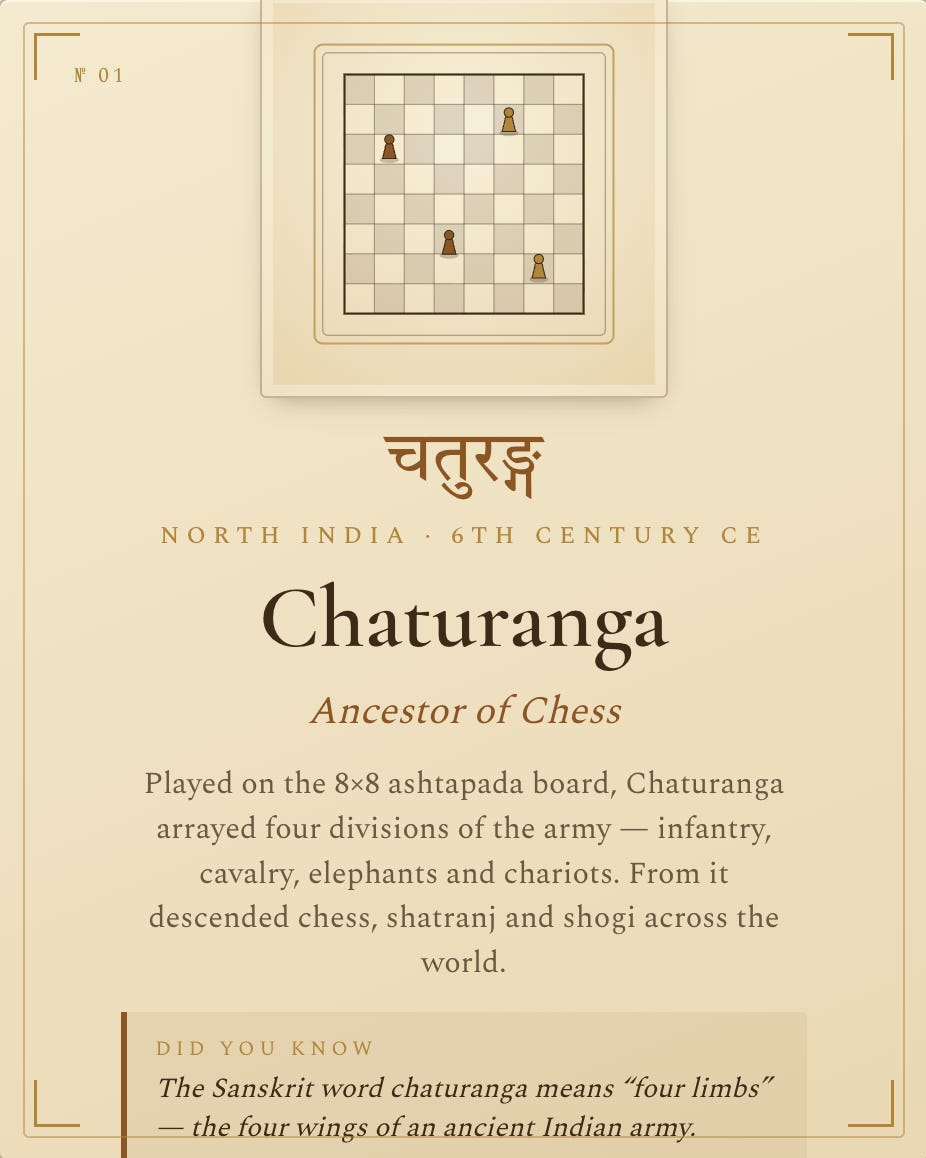
Developed around the 6th century CE, Chaturanga is widely regarded as the earliest known ancestor of modern chess. The game represented the four divisions of an army: infantry, cavalry, elephants, and chariots.
Unlike modern chess, the rules were different and often varied by region. But the core idea was familiar: outthink your opponent through strategy and planning.
Over time, Chaturanga traveled westward to Persia, where it became Shatranj, before eventually evolving into the game of chess played around the world today.
It’s remarkable to think that a game played in ancient Indian courts would become one of humanity’s most enduring intellectual pursuits.
🪜 Moksha Patam: The Original Snakes and Ladders
Most of us know Snakes and Ladders as a children’s game.
Its ancestor was anything but.
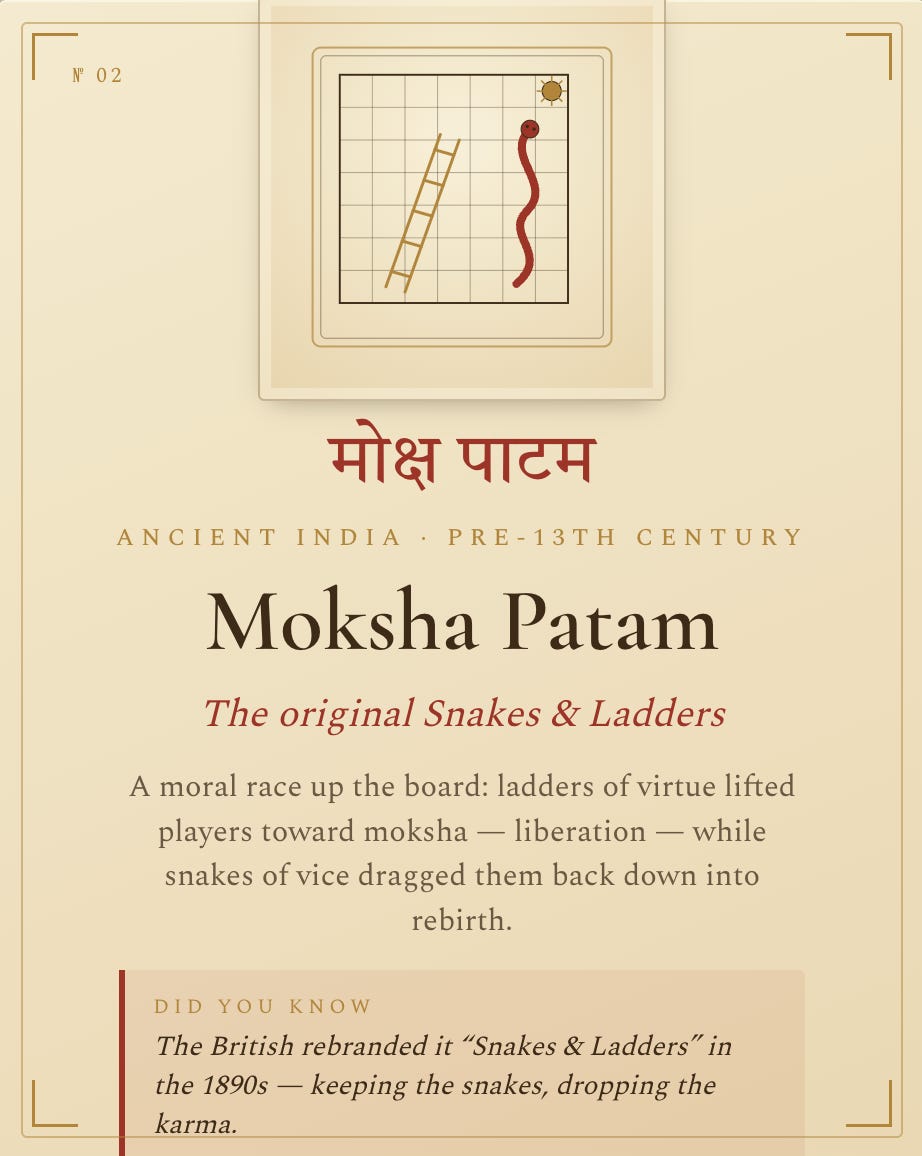
Moksha Patam was designed as a moral teaching tool. The board represented a person’s journey through life. Ladders symbolized virtues such as generosity, faith, and kindness. Snakes represented vices like greed, anger, and dishonesty.
Every move carried a lesson.
The goal wasn’t simply to reach the end of the board. It was to understand that good actions help us rise while poor choices pull us back.
Centuries later, the game traveled overseas, shed much of its philosophical meaning, and became the Snakes and Ladders we know today.
🎯 Pachisi: The Game of Emperors
Before there was Ludo, there was Pachisi.
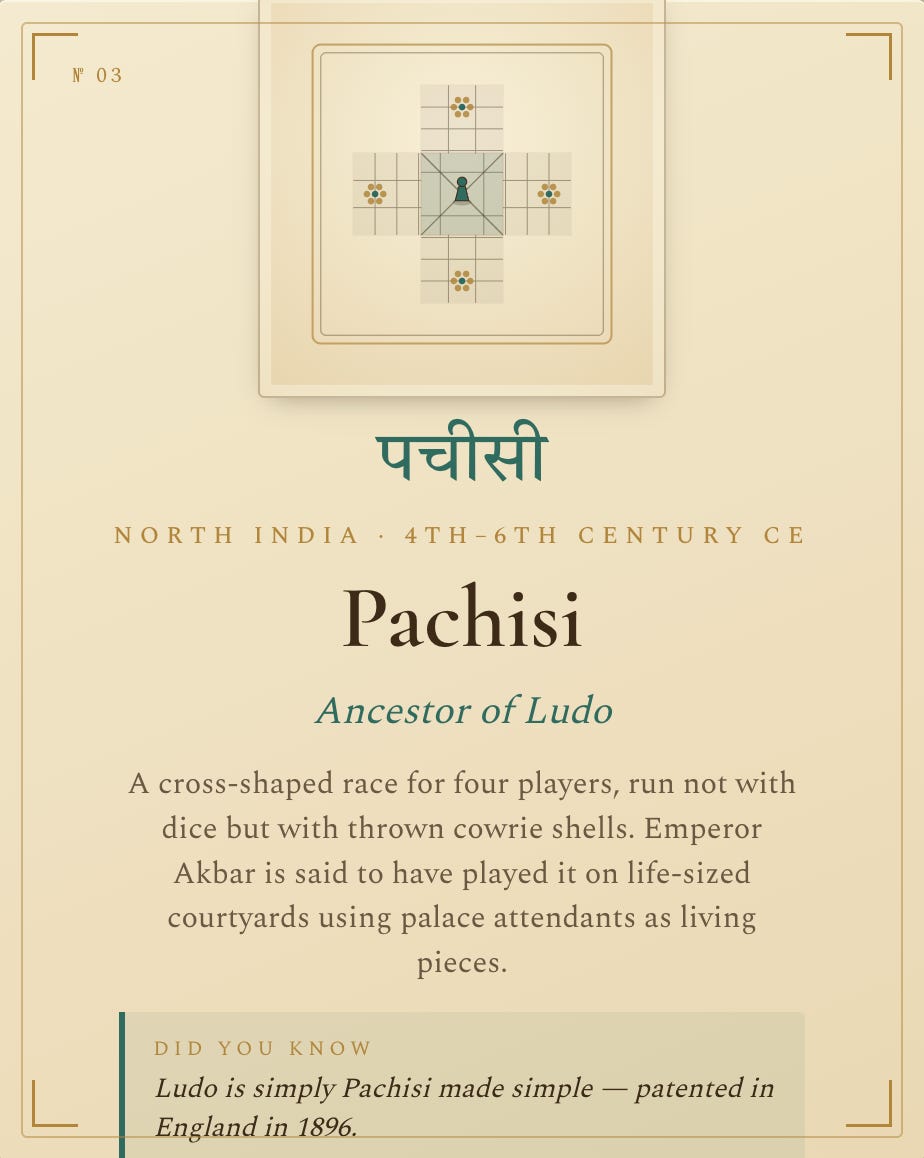
Played on a cross-shaped board and traditionally using cowrie shells as dice, Pachisi was one of the most popular games in medieval India.
Its influence was so widespread that many historians consider it the national game of India during that period.
One of its most famous players was Emperor Akbar. Historical accounts describe giant Pachisi courts where human participants acted as living game pieces.
Imagine a board game so beloved that an emperor transformed it into a life-sized spectacle.
Modern Ludo traces its roots directly back to Pachisi.
📜 Gyan Chaupar: A Board Game About Life
Some games teach strategy.
Gyan Chaupar taught wisdom.
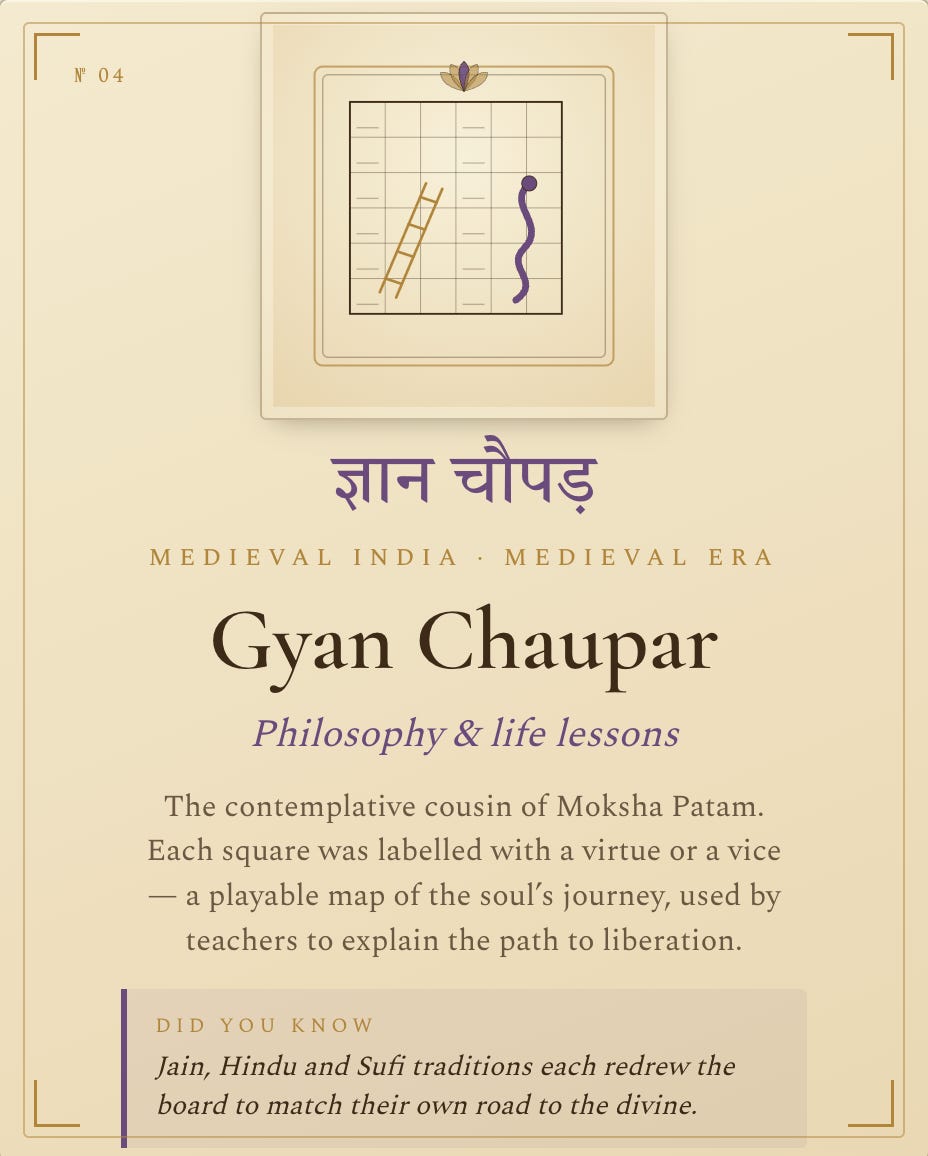
At first glance, it looked similar to Moksha Patam, but its purpose was deeper. Every square represented a virtue, temptation, challenge, or spiritual lesson. Progress wasn’t simply about moving forward—it was about understanding life’s journey.
Players encountered concepts like humility, compassion, ego, and enlightenment.
The board itself was a philosophical map.
In many ways, Gyan Chaupar wasn’t just a game. It was a conversation about how to live.
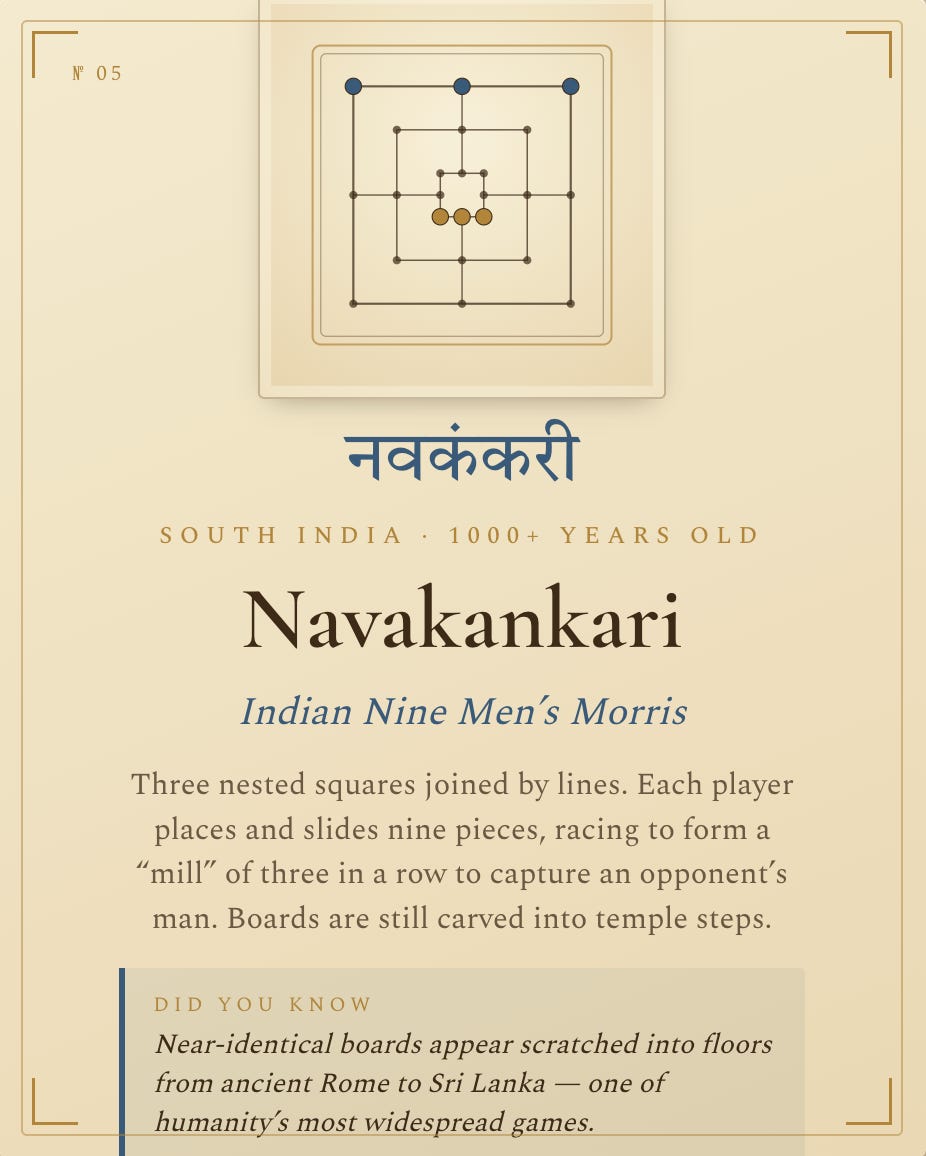
⭕ Navakankari: Simple Rules, Endless Strategy
Across South India, temple floors and stone surfaces still contain carved game boards that have survived for centuries.
Many of them belong to Navakankari.
The objective is deceptively simple: form rows of three pieces while preventing your opponent from doing the same.
Yet beneath those straightforward rules lies a game of planning, positioning, and anticipation.
Like many great strategy games, Navakankari proves that complexity doesn’t require complicated rules.
Sometimes all you need are a few pieces and a clever opponent.
🐯 Aadu Puli Aattam: Tigers vs Goats
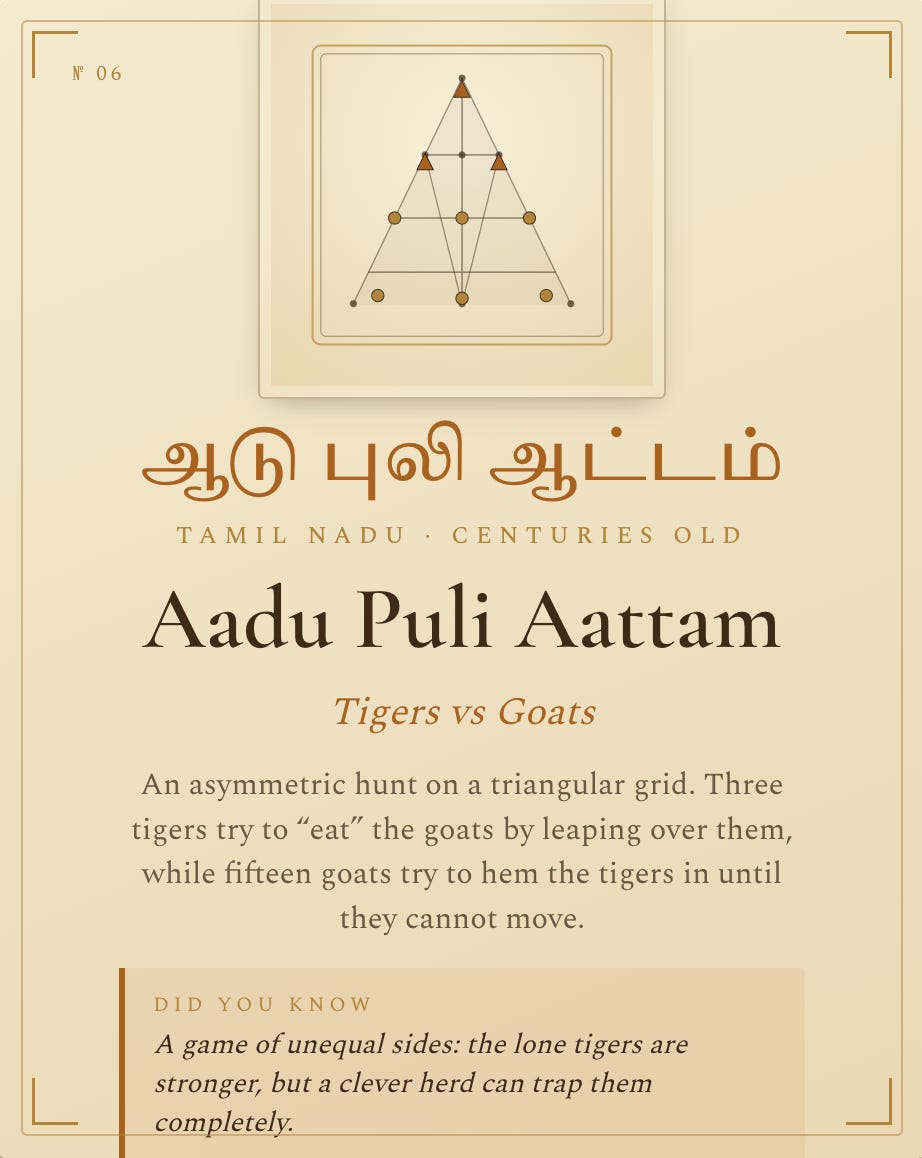
Few games capture asymmetry as elegantly as Aadu Puli Aattam.
One player controls tigers.
The other controls goats.
The tigers are powerful but few. The goats are weak individually but strong together.
The tigers win by capturing goats.
The goats win by trapping the tigers.
Every match becomes a fascinating battle between power and cooperation. It feels less like a board game and more like a lesson in strategy, leadership, and resource management.
It’s easy to see why this game has survived for generations in Tamil Nadu.
🐚 Pallanguzhi: Mathematics Disguised as Play
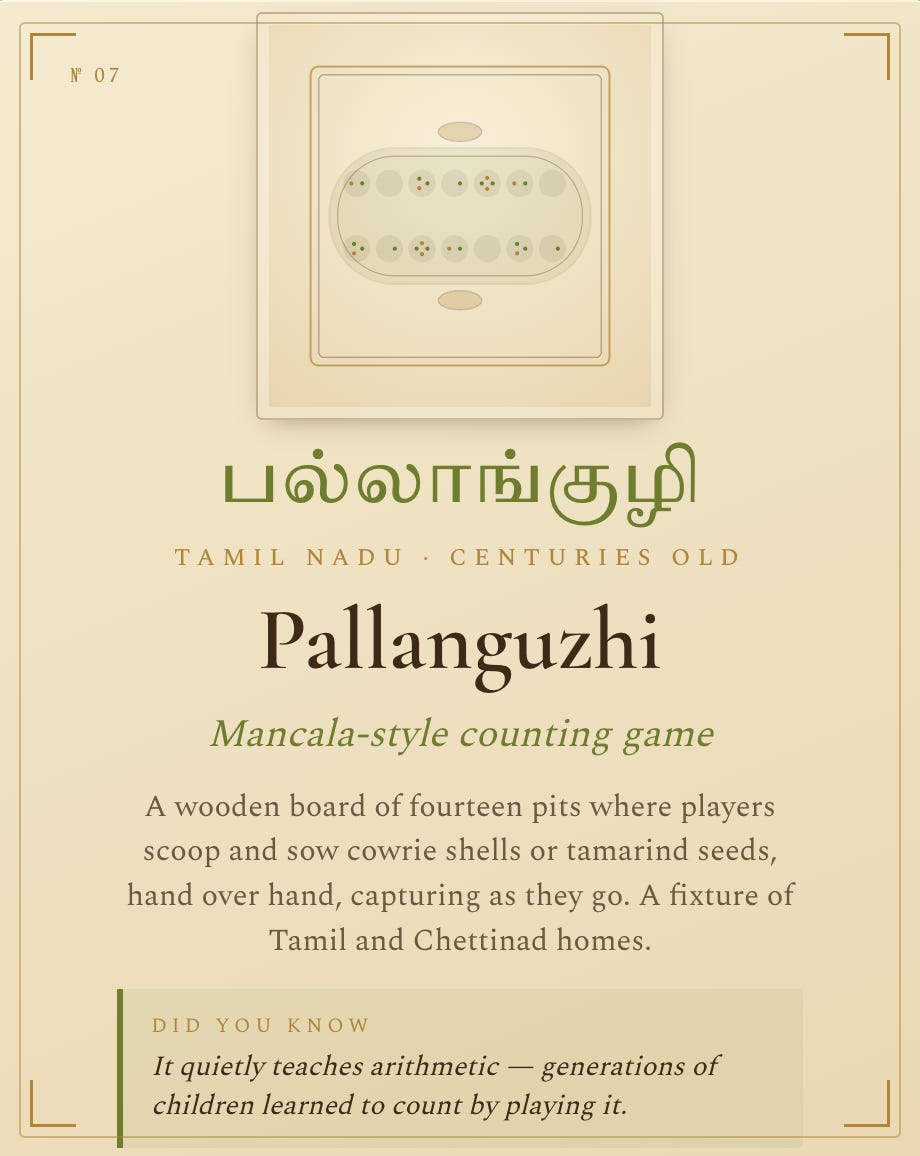
Pallanguzhi belongs to the large family of mancala games played around the world.
Using seeds, shells, or stones, players distribute pieces across a beautifully carved wooden board.
At first glance, it appears simple.
Yet success requires counting, planning ahead, and recognizing patterns.
For generations, Pallanguzhi quietly taught arithmetic and strategic thinking long before educational games became a category of their own.
Learning and play were never separate activities.
They were the same thing.
More Than Just Games
Looking at these games today, it’s tempting to see them as historical curiosities.
But they reveal something important about how previous generations spent their time.
These weren’t passive forms of entertainment.
They encouraged conversation.
They rewarded patience.
They brought people together in the same physical space.
They taught strategy, morality, mathematics, storytelling, and social connection—all without batteries, subscriptions, or screens.
Perhaps that’s why these games still feel relevant.
Not because they’re old.
But because the things they cultivated—curiosity, creativity, and human connection—never go out of style.
So the next time someone says board games are making a comeback, remember:
In India, they’ve been around for over a thousand years.
And some of the best ones are still waiting to be rediscovered.
Which of these games would you most like to play?